
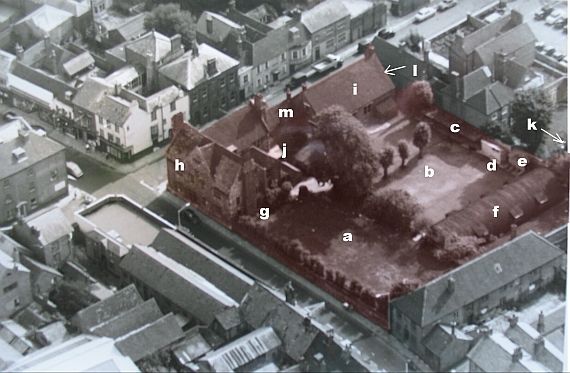
a: headmaster’s lawn (archery & other photogenic activities for school prospectus & to impress special visitors)
b: school yard, cadets’ parade ground etc
c: bicycle shed
d: WCs
e: urinals
f: Nissen hut (housing three classrooms)
g: Headmaster’s study
h: Form III (my first classroom)
i: Assembly Hall
j: kitchens
k: (off picture) the Cadet hut containing Quartermaster’s stores (rifles, boots, uniforms), instruction rooms
l: School gate: entrance for boys
m: library & Sixth form
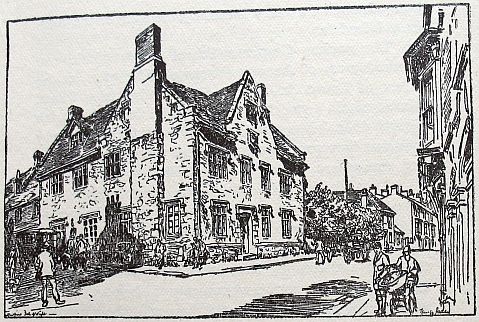
The main school building dates from 1610. Charles I was held prisoner there for a while before his execution.
When we got off the bus from East Cowes, Peter (see previous post Peter and Johnny) brought me to the school gates. The bell rang and each boy lined up by Form in the yard just outside the Hall. The Sixth Form prefects presided over this operation and kept us in line till we had ceased shoving and giggling and fidgeting and talking. Then we were released, quietest line first, to the Hall for morning Assembly. On stage came the Headmaster with flowing gown and noble forehead (see my last); the epitome of dignity and rectitude, the Head Boy at his side. In the background was a boy at the harmonium to accompany our hymns and play some processional piece as we filed in and out.
The Headmaster delivered a homily: courtesy, neatness, team spirit and striving for personal perfection were the attributes of the Christian gentleman, that glory of the English genius. It was our Christian duty, pleasing before God, to comport ourselves as gentlemen in the town, our schoolcaps properly on our heads, our ties knotted at the collar, our jackets buttoned, walking not running and so on. His saving grace was to be humorous and not obsessive about these matters; eternally tolerant of adolescent fallibility and understanding of the rough manners of boys on the Isle of Wight. It was a rural community where you could trace family names back over the centuries: Fleming, Oglander, Pittis. Many would inherit their parents’ business: drapers, farmers and brewers.
Morning assembly took about twenty minutes, everyone standing: the masters in a file down the left-hand side adjacent to the street. One morning the Head’s voice was drowned by the sound of pneumatic drills digging up the road outside. The Head Boy was despatched to ask them to pause till our “religious observance” had finished. Instant silence outside. The authority of the Presence worked even by proxy.
We went to our classes and the form-master would take the register, calling names: Bennett, Best, Cowley, Croft, Filby, . . . Rasmussen III, Smith, . . . But in case you might arrive in school late and miss some of Assembly, a prefect had been stationed at the school gate to take your name. It happened to me in my first week. A grinning Sixth-former with a gold tooth and greasy quiff told me to comb my hair and polish my shoes next time as he wrote my name in the “late” book. I was indignant.
Do not imagine that the school was a grand place like the English schools you may have seen in movies, perhaps Hogwarts, the academy for wizards. It was plain with bare walls and floor-boards. In Form III, the desks were in joined rows with backless benches attached like pews; the wood blackened and carved with initials and obscene designs from down the centuries.
It wasn’t an expensive school: £15 per term when I started, plus 2s 6d per week for school dinners. The food was much better than at my boarding school. The headmaster whilst awe-inspiring was approachable and kind: reassuring after my previous experience of the eccentric Monty Brummell-Hicks*.
 a wayfarer’s notes
I have no childhood photos of my own. All the bridges were burned, I escaped with nothing. Maybe someone alive has some. But this year, by some extraordinary twist of fate, the headmaster's only daughter Jane visited me—me of all the pupils who had passed through that school—and pressed on me a small case full of photos and memorabilia. Now I have photos of all the masters, all the boys including myself. (no scanner so I photograph them again, which is why they aren't quite square.)
LikeLike
You may not have many photos of your childhood, but you sure do have a lot of memories! I am envious of your ability to remember many details from you childhood. I hardly remember anything.
LikeLike
The boys in the photo appear to be what we here in the states would call high school age. What age might you have been when you arrived at this school?
My high school years were less dignified. And certainly my schoolmates were more experienced in tom-foolery than comporting themselves as gentlemen.
Alas, I had few teachers who carried themselves with the kind of dignity of your headmaster.
A good friend of mine went on to become a dignified, although at times unconventional vice principal. He married the daughter of one of my math teachers.
I have few photos from those days and none taken at school.
LikeLike
Sophia, I wrestle with those memories, demanding of them more than they will yield. They are my photo album, but they are snapshots only, and they come as jumbled-up incidents, as if the photos had fallen out of their timeline, and I have to examine each like a detective to determine its context within the whole.
Sometimes memories are false, too.
LikeLike
I was 12 when I arrived, Charles. An information sheet amongst my case of materials tells me that the junior school started at age 7. I was there till I was 18.
In those days 2% of English children reached university: it was therefore a high distinction. But at my school I don't think anyone had been to university in living memory: I was an exception and stayed an extra year in the Sixth Form to gain a State Scholarship, which was even rarer.
LikeLike
And Charles, the boys at our school were very good at tomfoolery! By being a stickler for dealing with minor infringements, such as not wearing a cap whilst in the town, the Headmaster defined the scope of rebellion against his authority. It was the good name of the school which occupied him I used to think, but one incident makes me think differently.
Some pornographic photos were circulating and I saw them in the school yard. From their format (8″ x 6″) and style I can retrospectively be certain as to the perpetrator. But the Head, whilst treating it as a very serious thing, was not in the slightest concerned about us being corrupted. He was indignant on behalf of the lady concerned: the intrusion upon her decency and privacy. This was typical of him, to idealise women and be tolerant of the shortcomings of humanity in general.
I have never seen photos like them since: extreme close-ups of female genitalia, more gynaecological than arousing, I thought at the time.
They must have been done by my closest friend there, who was an accomplished photographer and whose father was a main publisher of scenic postcards in the south of England. He seemed to have no trace of vice in him, and I wonder in fact if the photos had used his sister as a model.
LikeLike
That is a wide range of ages of boys in your school. The earlier years (from 12 to around 15) are the most difficult as we go through that nasty puberty stage.
Here we separate them into middle and high school.
My middle school years (12-14)were the most difficult. I mentioned some of my misadventures in earlier comments.
One of the starkest differences is in how we dressed. I wore t-shirts and jeans as much as I could get away with it. And in my day bell-bottom jeans were popular. I remember a pair of red, white and blue striped bellbottoms I was particularly proud of.
I also lived through many cold snowy winters. It would have made sense to wear boots, but I insisted on wearing my sneakers all through the winter. For some reason this was a sign of toughness. And I needed all the help I could get in that area.
I also remember that it was considered bad form to wear jeans that were not battered by wear and tear. I recall intentionally shredding the cuffs of some new jeans and slicing the knees out so that they would not look crisp and new. Much to my mother's dismay I might add.
Wearing anything on my head when it was not winter time would have been considered odd I think. So the fact that I ventured into town without a cap would not have raised any eyebrows.
Funny how time and distance changes what is considered rebellious. But I suppose kids are the same everywhere, just working within the local parameters.
LikeLike
These comments covered about all my wonderings Vincent, ages, dress, hidden vagrancies or at least vagabondnesses, lol, yes I can see this well groomed and dressed up bunch peeing on roosters and raising plenty of ruckouses, no doubt, normal healthy young men.
The differences are striking, between the states and your country, dignity and respect to a higher degree with yours, far less with what I knew, I had very few teachers that earned any respect, most were way too in to themselves for that, so the kids gave them their come-upence often enough. Like setting fire to the trash can full of papers, performing near sex in the back of the room during class, things like that happened once every couple of weeks or so. I hear that it is worse and these extremes are more frequent now days in most usa public schools, can't say for sure.
Also, we always had rogues, tough guys who even bullied most of the teachers and got away with it. Fear, you know. How things ever worked our I don't know, just did I guess. I quit going early in my last year, left school unofficially and got a full time job, they graduated me anyway, why, I never knew. College wasn't even a possible then, Vietnam and the all pervasive draft was in charge. Cannon fodder.
Nowdays, the schools are carpeted, air conditioned, and many of the classes are far more 'fun' than they ever use to be.
Wonder about the difference in your country, between your time and now?
LikeLike
[…] My New School The school yard He was a veray parfit gentle knight Memoirs Continued – At Mrs Jenkins’ Head’s Sermon at St Thomas’ Church July 1958 […]
LikeLike