
Remembering Paul Maurice Martin
Paul writes:
One time I think on another blog you jokingly referred to agreeing with me for a change. But I’m not convinced you disagree most of the time so much as that you have your own outlook on life. My sense is that you tend to respond less to the content of my posts in their own terms than to point out how they don’t express your own outlook!
Vincent responds:
I’d be interested in seeing you do one or more posts on your outlook on life to get a better sense of where you’re coming from.
You’re quite right Paul that I do not respond to the content of your posts in their own terms. I’d been aware of it for a while and last Friday had thought of answering you in a post here instead of commenting on yours as I did. We are thinking on similar lines.
First something else: you once thought I was a girl because of the name Yves. It was only yesterday I discovered that the new Blogger allows it to be changed. Vincent is my seldom-used middle name, so I am no longer hiding behind a nom-de-plume picked up randomly from a music album cover.
“Outlook on life” is a good phrase, for it avoids mention of “beliefs”. In my outlook, the terms you use in your post—religion, faith, worship, saint, saintly—represent archaic ideas. I am not “for” them, but to be “against” them is to engage with a phantom enemy.
Over the last 3 or 4 years, I have ditched beliefs and even rational constructions as much as humanly possible. What remains? Immediate experience of senses and emotions. What directs my behaviour? Largely instinct and intuition. Intellect is required to use language, and to work for one’s living; but it’s a hopeless guide to life as a whole.
Making this intentional shift of one’s centre—away from intellect and towards the body or animal nature—has shown me that there exists a “natural virtue” as Jean-Jacques Rousseau, on the cusp of Enlightenment / Romantic age, would have called it. Rousseau and the various religions formulated their outlooks before the Darwin bombshell. Christianity is like the Irishman’s broom: it claims to be the same one though it’s had many changes of brush and a few changes of handle. Some sects still deny evolution altogether: a proof of its power to destroy the old certainties.
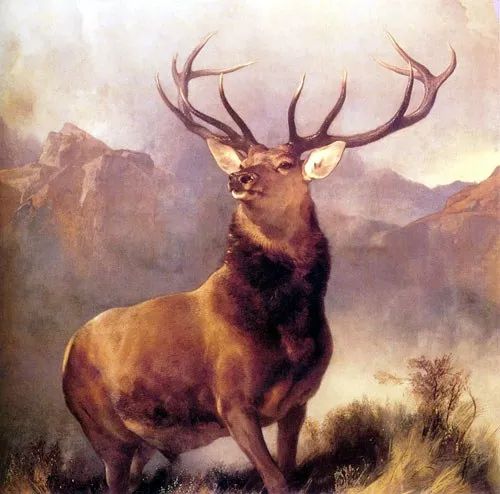 As the elk (Red Deer in UK) is a mammal with overdeveloped antlers, man is the mammal with over-developed intellect. It’s the product of evolution and we have to do our best with its drawbacks. We imagine gods, we make up notions of virtue and sin. We overvalue technologies and are blind to the vexations they cause. Individually and collectively, we constantly adapt and make the best of things. We construct cultures and transmit them. Do they clarify the world for each succeeding generation, or add more confusion? This is something we need to face honestly.
The fish is not the pond. You and I are not our culture. We can escape our pond, swim down a stream, find an ocean maybe, or just another pond.
In different cultures we find the same idea: Brahman, Logos, Psyche, Anima, Spiritus. They all invoke the concept of a soul (ghost in Nordic languages) which breathes life into a body, and leaves it when we die. St John’s Gospel begins: “In the beginning was the Logos”—which literally is translated as Word.
Modern cosmology, evolution and genetics since the discovery of DNA provide other myths which withstand detailed examination and render the religious ones unnecessary. They explain life. Yes, I still call them myths, but it doesn’t mean that I worship at the altars of Science, especially when it denounces people’s beliefs.
Blake said “Everything possible to be believed is an image of truth”. From that point of view, everyone’s outlook is of equal value. I seek out those who talk of Spirit for I share their priorities; but want to say that we can go even further in freeing spirit from archaic trappings.
To me as to you, what we call Spirit is the most important thing, and it doesn’t really matter that we differ in ideas as to what it is. But we may not yet be ready to talk in the same terms.
 a wayfarer’s notes
And another thing. Did the first life , whether it be protein or amoeba, happen because God breathed soul into inanimate matter? If not, then at what stage did soul have to be breathed into matter to bring it to life? Only with Man?
I asked the question a long time ago in this blog: see “Do fish have souls?”
LikeLike
And yet another thing. When in his blog post Paul speaks of “sane” and “saintly” and whether they have similarities to one another, I see that they do have one thing in common.
They are admired adaptations. I mean that the “spiritual quest” that occupies some of us so much is the quest for a form of adaptation so that we can get through life and cope with what it throws at us.
To be sane and/or saintly is superior, we think, to being wealthy. We are certain that it is superior to being a warlord who kills his enemies and is flattered by his friends.
They are all different forms of adaptation and we are entitled to rank them.
As Paul said in his previous post: “Other times, it’s simply obvious to them that those human qualities that are most admirable and worthy are, by happy coincidence, the very ones that they happen to possess themselves.”
This doesn't just apply to the “Ptolemists”: it applies to everyone.
LikeLike
I have always been conflicted when it comes to using the word “spiritual” in describing my own beliefs.
Too many people equate this with a belief in a disembodied soul that transcends physical boundaries.
If I were to invoke the word, it has more to do with an intuition, or instinct, for which we have no scientific explanation.
Personally, I think a scientific explanation is possible, but our abilities (or rather limitations), are incapable of revealing the true nature of them.
I have often wondered what it would mean to our species to have all these mysteries resolved.
Would it change the nature of us as beings? Would we consider it an advance, a distraction, a curse?
I particularly like this part of your response:
““Outlook on life” is a good phrase, for it avoids mention of “beliefs”. In my outlook, the terms you use in your post—religion, faith, worship, saint, saintly—represent archaic ideas. I am not “for” them, but to be “against” them is to engage with a phantom enemy.”
Phantoms of this type have been used over and over again to manipulate thought.
Today the specters of Terrorists, Axis of Evil have been brought to life in order to influence action from those who would not ordinarily be inclined to act.
Hell, the wrath of various gods, heaven, saintliness, and righteousness all specters used to influence behavior.
I don't believe in or trust in ghosts, gods, or spirits.
When they are manifested by those around me in an attempt to influence my thinking or actions, it serves only as a cloud of confusion, rather than revealing any truth.
I am currently re-reading “The Moon is a Harsh Mistress” – by Robert Heinlien.
Professor de la Paz describes himself as a Anarchist individualist.
He describes his beliefs as follows:
“A rational anarchist believes that concepts such as 'state' and 'society' and 'government' have no existence save as physically exemplified in the acts of self-responsible individuals. He believes that it is impossible to shift blame, share blame, distribute blame … as blame, guilt, responsibility are matters taking place inside human beings singly and nowhere else But being rational, he knows that not all individuals hold his evaluations, so he tries to live perfectly in an imperfect world…aware that his effort will be less than perfect yet undismayed by self-knowledge of self-failure.”
…
“I will accept any rules that you feel are necessary to your freedom. I am free, no matter what rules surround me. If I find them tolerable, I tolerate them; if I find them too obnoxious, I break themn, I am free because I know that I alone am morally responsible for everything I do.”
LikeLike
To me, a basic problem is that words like spirituality, religion, faith, saint – and, most certainly, God – have denotations and connotations based on various belief systems. Like you, what I’m interested in discussing is direct experience.
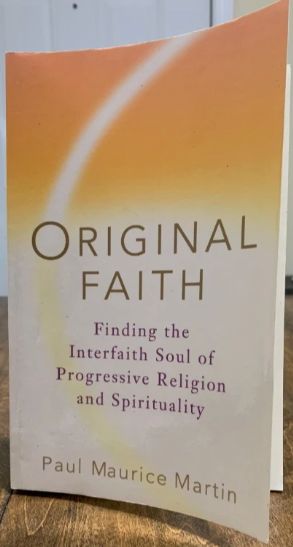
In blog posts, I find I can only manage to at best suggest how, for lack of a better word, it’s possible to discuss spirituality without reference to belief. That’s why, for example, I take a chapter and a half in the book to discuss faith.
One benefit to focusing on experience is that it changes the conversation from an endless debate about things that can't be proven to more like: “Hmm… is that true to my experience too?” As members of the same species, it's easy to find some common ground.
LikeLike
Thanks Charles. We appear to be regularly in agreement.
Paul, I do understand the predicament of writing on spirit. In fact I am pretty unhappy with my latest piece above for it tells only a part of what I need to say, and is misleading on its own.
LikeLike
Hullo, and a happy new (old) name to you! I too changed the name on my blog.
Natural virture – thank you for bringing up this term. That is what I am also trying to find and reach.
LikeLike
Vincent indeed! Noble, and right about very many things, concepts and ideas. Man, where do you get the energy? But you are unintentionally impressive, all the while, honest above all.
Good to meet you Vincent.
LikeLike
Jim, Rama, & commenters all. You probably don't know how encouraging you are, to this wanderer in the dark!
LikeLike