
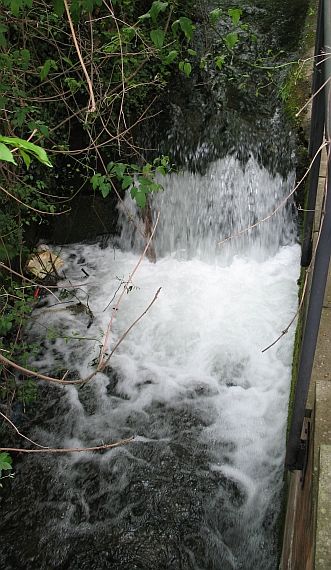
It’s less than a week since I posted last but seems longer; and then it gets harder to try and distil the impressions and thoughts of several days into a short space. One thing: I wanted to lead you by the hand and show you “my” waterfall (100 yards from my door) but a photo must take the place of that childish gesture. I have no garden, just a rented flat but like Diogenes, the less I have the more I can claim as my own *. He was the originator of the Cynic philosophy, not cynical in the modern sense of denying the goodness of human nature; but cynic as in κύων, cyon, dog. He and I have in common that we rejoice in man as animal, though I don’t live in a barrel and perform acts of grossness in public. My writings unlike his are preserved so you can know me directly, whereas we only have salty anecdotes about him.
Another philosopher was on my mind today, René Descartes. If I recall correctly—anyone can check the Net but I prefer the distortions of memory—Descartes was holed up in Holland far from home one cold winter, huddling up to a stove behind which could be heard the sound of crickets wintering in crevices. He eschewed the baggage of traditional concepts and tried to reason everything from first principles, famously proving his own existence through the observable fact of his “cogito”. I’m less impressed by reason and try not to rely on it. What interests me is instincts and feelings, particularly those which show that the “spiritual” is an outgrowth of human life’s full-time preoccupation: how to get by.
It seems to me that civilisation has tried to take us away from “brute” existence; tried to show that we are above the beasts. It’s part of my method on the other hand to reject all culture in order to rediscover how we become what we are, whether above, below or equal to the beasts.
What is it to be human? That is my quest. If I have to behave eccentrically to get there, so be it. I consider my own lifelong tendency to rebellion and solitude, a perennial sulky teenager outcast in a wilderness of his own creation. Has it been a self-imposed penance or was it simply the best I could do at the time? Everyone’s behaviour is adaptive, a way of trying to get by. The philosopher is no exception when he thinks and publishes. What we all do from birth onwards is carve ourselves a space in this world enough to sustain life. Hunters did this in forest and plain. Peasants succeeded them, holding land for pastoral and arable farming. Nowadays this has become “virtual”, a handy word: we have learned to deal with tokens, not real things.
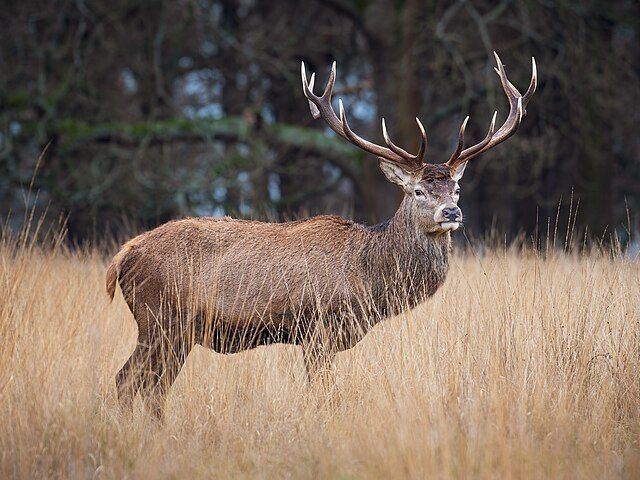
The core of my philosophy is to convey that intellect is not the organ for discovery of truth, but a useful weapon as well as an overdeveloped excrescence for display purposes. The human cerebral cortex has got so sophisticated that we can’t cope with it. To understand overdevelopment, consider the antlers of the red deer stag.
If you have reached this far, I am sorry to burden you with such a heavyweight thing as a philosophy: yes, heavy like antlers! We know that thinking hurts but we have to go to school anyhow and learn it, because life in this world is a permanent rutting season, and male or female, we are forced to grow unwieldy antlers to compete and display. What else is blogging?
But lest my philosophy sound top-heavy, a story of alpha-male dominance, I protest it’s the very opposite. I’m about to present its core secret. The drums roll, the fanfare sounds, and you would expect at this point a collection-plate to be passed around for contributions before the magician performs his most astounding trick. But no need for that: we’re family here, share and share alike in trust.
Everyone’s special, therefore everyone’s ordinary.
Not seeing the intrinsic glory of being human, we try to be special. We compete and get stressed and have beliefs, and before you know it we are hooked on elitism and prejudice without being aware of it. Don’t think that with these words I am promoting a political correctness agenda. No, no! The opposite.
What I celebrate is the ordinary: acceptance of the given. Not to change the world or escape from it, but to submit to its embrace. Like Diogenes, I want to point out that our needs are simple, even though we carry the burden of beliefs and culture on our heads and get entangled in thickets. Let us not get mired in scholarship either, saying, “Oh this sounds like the Tao te Ching!” or some other philosophy. We don’t need books. (It takes a bold writer to say that.)
We already have all the equipment we need to discover what it means to be human, and no one “out there” can tell us.
* See also this post.
 a wayfarer’s notes
… since our ears ARE tuned to the inner call.
More strength to your pen (typing fingers!).
LikeLike
Thanks Rama. I need more strength to my pen because this piece probably does not succeed well in conveying what I wanted it to. But I'll keep trying.
LikeLike
Am I wrong in thinking that the world, with its bad as it is, is right, in that this bad is true to our animal/physical body instincts?And that, were it not for the mess of the intellect, there would be less of it?I'll be happy to agree that it is man's intellect that has him justifying the use of his harmful instincts, even depends on his using them in order to claim superiority over those instincts and turn back on him and enslave him, help him invent laws to encage him, laws which will oppose the instinct and bring them out in more and greater ways.Or am I missing the point?Good to read you, Vincent, nice waterfall. And do keep writing.
LikeLike
I'll answer you at length, Jim, I think in a whole blog post. Thanks so much for raising these vital points!
LikeLike
I’m commenting on a vintage post, but I do think you are valuably right here, that the key determinant in human behaviour, including philosophy, is in “getting by”.
LikeLike