
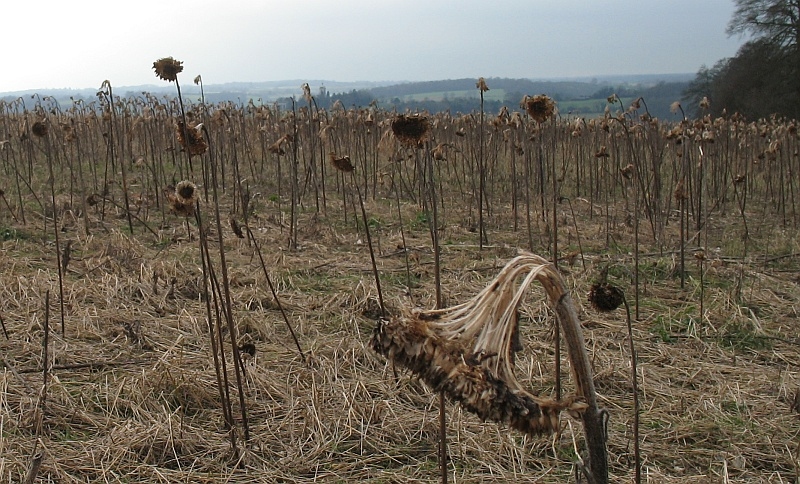
Visits to the sunflower field in Downley, mentioned three times before, have become a private ritual. These unharvested crops survive like invincible peasant crones. In Italian, the sunflower is the girasole or “turn-sun”. Its sun-worship is enabled by fibrous sinews in its “neck”, made of certain cellulose molecules, and these don’t decay as rapidly as fleshier plants. So skeleton sunflowers can stand like ghosts at the end of January.
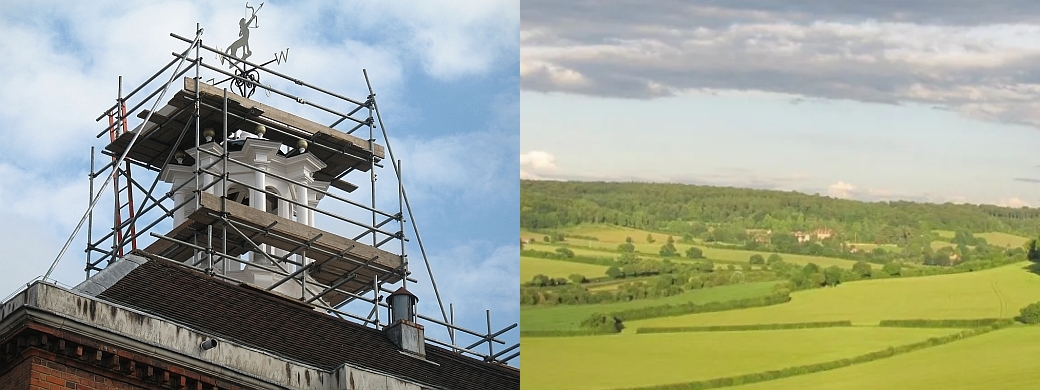
 On my way to the field, I was surprised to find a flock of sheep, of an unusual breed, busily munching on a field of turnips. An electric fence had been put round them because it’s common land normally left open. I’ve passed many turnip fields in the winter months round these parts and wondered who would want them, as they were misshapen compared with those in the supermarkets. Sometimes I’ve found a few already uprooted, and taken them home for the pot, whilst scouring the horizon like a guilty thief and expecting a farmer to shout “Oi!”.
 Now I’ve added turnips to the list of local unharvested crops: they seem to be just for sheep and pigs to graze. The others—sunflowers, maize, millet and buckwheat—are grown as provender for pheasants, whose numbers would not be sustained otherwise, given the shooting season. Farmers have also dotted the fields with blue plastic drums dispensing wheat grains. Pheasants are not a native species and seldom wild, just “free range”: though they’re nervous and untameable.
I had meant to write on rituals and holy places, but haven’t left space enough to do justice to the topic. I’ve felt why the town of Glastonbury is so renowned. It has a special energy. It was a holy place before Christianity. I believe the vibration is made stronger by each act of pilgrimage, for I feel something in particular spots, and can tune to this feeling more easily with each successive visit.
Naturally we seek reasons, for the intellect is our brain’s latest technology. Scientists love to debunk superstitions, but homo sapiens thrives on ritual. Rationalising merely yields the baggage of beliefs, which filter and muddy the experience. The basis of ritual must be feeling and not superstition.
Rationalists have it wrong when they sneer at rites and fetishes and holy places, for these are not harmful, nor even the beliefs, in themselves. It’s easy to see that human beings are not designed to be exclusively rational, even though the European “Age of Enlightenment” still influences us after more than two centuries.
The harm comes from the tentacles of power, whereby one man or mind manipulates others, whether through religion, spirituality, science, politics, academia, marketing or media. Add a gallon of wine to a barrel of sewage, and you get sewage. Add a teaspoon of sewage to a barrel of wine and you get sewage. Power over others is sewage.
In private nature-rituals, invented naively, I find an uncorrupted gateway to ecstasy.
 a wayfarer’s notes
what a lovely habit. I don't know of any habits of planting for the wild animals here, except for those of us who garden and include them. Well, I did know a man who always planted a field of rutabagas for the deer. But that was because he knew it insured that he'd have venison every year.
LikeLike
Well I am afraid the reason here is exactly the same as the rutabagas for the deer. Pheasants are big business around here, and the Chiltern Hills support a heavy population, destined to be shot by organised shooting parties; or the same hands which have fed them.
Farming is unsentimental. At Ham Farm, which I pass on many walks, they have Easter Lambing Open Days, where grandparents and little children have rides round the farm, and see the newborn lambs, so lovely gambolling with their long shaky legs. A year later and they are sent to slaughter.
LikeLike
i loved this comment more than the post itself!
really, the lambs are so ecstatic before the final moment of the their death. or may be, they know everything from the very begining. who knows?
LikeLike
Found via the Wayfaring strand, I’d probably have missed it otherwise 🙂 . We regularly go to Glastonbury to fill up water bottles from the spring. We last did it on New Year’s Day, and were surprised to find we could get a marvellous lunch from the Rainbow’s End cafe (albeit only takeaway). It certainly is a unique kind of place, though much of its accretion of mythology in the Middle Ages seems to have been farsighted scams. But that’s part of the magic somehow.
LikeLike
You’re lucky to live close enough to Glastonbury for such a trip. I was going to mention one of my favourite posts “At the Blue Note Café” but you’ve already read it—on October 16th, 2014. It’s categorized it under “Connexion”.
LikeLike
[…] “By some instinct I was drawn to a solitary pilgrimage, on New Year’s Eve, away from the twinkling Christmas tree […]
LikeLike