
I don’t normally post extended quotes, but this—including the dead frog—expresses in more masterly language what I would have liked to write today.
“When one considers how dependent we all are—especially such parasitic weaklings as artists, poets, writers, priests, philosophers—upon the hard one-track energies of the industrious producers and shrewd traders, it seems only fair to make our obeisance to enterprise, strength and cunning, before we proceed to show the limitations of such things. If we refuse to make such an acknowledgment, if we indulge in unqualified abuse of the solid, sterling qualities upon which our very existence depends, there is a danger lest our protests, instead of representing a free, detached wisdom, should represent a weak, violent, impotent rage.
“If we are not blinded by prejudice, we must confess to observing, every day, how many among the competent, energetic producers and traders are honest enough in their ‘deals’ and prepared to show indulgence, at a pinch, to their less sagacious rivals. We must also confess to observing how there often radiates outward from one of these successful men a vigorous aura of general well-being, of which all sorts of weaklings living at the circumference, so to speak, of this centre of energy get the benefit. Let us therefore make our bow to these dynamos of unsympathetic force. But at the same time let us remain devotees of happiness.
 “But what of those weaker and poorer than we are? According to what we call necessity, we stubbornly go on our way, leaving so many consciousnesses behind us obviously suffering from various degrees of tribulation, such as, if we stopped and took the trouble to concentrate upon them, we might, after repeated and patient efforts, materially relieve. It is according to necessity, too, that we pass by the dead—pass them by, and unless they be of our own flesh-and-blood, take small thought even so much as to bury them!
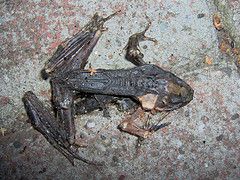
“I picked up a dead frog this morning. Withered it was to a veritable husk of hollow emptiness, like a snake’s skin bleached by months of burning sun. I suppose many a bird had hopped against it, brushing it with wings or tail, many a butterfly settled above it, many a rabbit spurned it with unstartled, jerky indifference. Why should they care?”
From John Cowper Powys, In Defence of Sensuality, a self-help/philosophical book published in 1930.
Postscript, June 2018
Powys goes on:
According to what we call necessity, we stubbornly go on our way, leaving so many consciousnesses behind us obviously suffering from various degrees of tribulation, such as, if we stopped and took the trouble to concentrate upon them, we might, after repeated and patient efforts, materially relieve.
Which beings me to another “parasitic weakling“: Lokesh, from Ghetu’s story, “The Wretched“, published in my previous post. He is the anti-hero, who feels deeply about suffering. He tries and fails to understand the indifference of his fellows, whether it be the victims of terrorism and poverty in Mumbai generally or one starving cripple who catches his eye. His heart bleeds to the extent of bringing on a psychotic episode where he cowers among rats in the darkness until he realizes that they, like everyone else in the world, have no time for him. I guess he feels guilty for having so much when others have so little. The price of appeasing his conscience would be to give up all his privileges to help the poor and disabled.

But then there’s Ravi the other main character in Ghetu’s story, who displays “solid, sterling qualities“, for he is one of
these successful men who radiate a vigorous aura of general well-being, of which all sorts of weaklings living at the circumference, so to speak, of this centre of energy get the benefit. Let us therefore make our bow to these dynamos of unsympathetic force.
He’s quite unburdened by any of this bleeding-heart baggage. Untroubled, he simply gets on with things , performs the needed acts.
As to which of them is the more useful or virtuous in today’s world, Lokesh or Ravi, I cannot say. This is not a sermon.
There is Yin and there is Yang. One cannot exist without one another. And so it is with all the different kinds of people in the world: Levites, Samaritans, Marthas, Marys, Lokeshes, Ravis, Gopals, Ghetus, Anup Roys, terrorists, their shadowy “handlers”; politicians, news outlets, Hollywood, Bollywood, capitalists; you and me.
PS When choosing today’s illustration, I discovered that Flickr, the free online photo-bank, has 500 snaps of dead frogs, not including those about Dead Frog Beer, a Vancouver speciality.
 a wayfarer’s notes
Hullo! Your Powys quote was most apt vis-a-vis my own ruminations yesterday-today. My post yesterday on the urban poor. And last night I was reading last week's “The Economist”, where there was an article on the knowledge economy. I was struck by the complete disregard of the more fundamental question of “values”, which must underpin any analysis of “knowledge”. So I wrote out a response and sent that!
I've not read Powys, and thanks to you, I shall do so now. Best, rama
LikeLike
As I transcribed it, I was thinking of what you have been saying in your blog, and I nearly sent you a note to tell you about my latest, but then I thought you'd be reading it anyway.
Some of JCP's work is not currently in print, but almost everything is available second-hand.
LikeLike
This post really makes one think. I clicked onto your site for the first time after reading Rama's post on the urban poor. Both you and Rama allude to values. You offer some interesting perspectives.
BTW, your postscript about the number of dead frogs on Flickr really caught me by surprise. I learned something new today.
LikeLike
Dead Frog Beer?, 500 pics of dead frogs? Oh, Vincent, I am rolling on the floor, LOL! And I take offense at being called a parasitic weakling, just because I do not concentrate on matter.And my rages are not impotent ones, they are usually productive!Artists have always had to fight this attitude, this attitude is why football gets all the money and the humanities gets nothing, why community colleges stopped being institutes of higher learning and became vocational training depots. And guess who is behind these narrowminded manipulations of talent, the Religious fundamentalists, the religious fanatics, the ones who want to profit by exploitation, who want to deprive a human being of a life outside of earning to eat and work only. See them turn work hours into 24/7, do away with the days off, do away with family time, bring the women into the job place and throw the kids into daycare which cost so much one has to have two jobs just to be able to continue working one.Sorry about the raging rant. See ya later.
LikeLike
Delighted to have you pass by, Deb S. and I hope you'll come again. I've been brooding on your interesting comment about values, conscious that I never use that actual word. The dweller in the parched desert sets his compass by the location of the nearest oasis. In the same way, the worker in the halls of Mammon (or as a Rasta would say, Babylon) sets her compass by Values.
Meanwhile the naked rapacity of certain corporations and governments is carefully cloaked (either the full burkha or the rudimentary figleaf) in Values.
I confess that the territory I occupy is the heart of the oasis, where greenness is everywhere and even waterproof boots get soggy in the saturated ground. So I don't think of it as an oasis, but the hills and valleys of my homeland, which can embrace the whole earth with their life-supporting moisture.
PS Sorry to drown you in an overdose of metaphor.
LikeLike
Jim, on the contrary I'm delighted at your rant, it's your turn! I have been ranting enough on your blog as you well know.
I apologise on behalf of the late John Cowper Powys (who died in July 1963 aged 92) for calling you a parasitic weakling. But that was his self-deprecating humour. He spent nearly 30 years of his life in the US on a lecture circuit which included Cooper Union in East Village NY where he inspired the young Henry Miller to a life of literature, not to mention countless other amateur poets, philosophers and lonely self-educated janitors and intellectual drifters. He was the most compassionate of men, & I've just been re-reading in that same book his injunction to the reader to give to each beggar the requested quarter for a cup of coffee. Powys always treated beggars and bums as equals.
I'll finish with another little quote from the book: “No, not many of us are born to be saints. But it is the saints alone that enjoy that lovely magical flowing sensation of being free from remorse.“
Powys was a super-sensitive person who hated cruelty (against fellow-humans or animals) above all else. I think he had to die in '63 for I don't know how he could have survived in today's world.
LikeLike
[…] in his own poetic way, suggests that the compassionate and the predatory sides of humanity are the Yin and Yang of life. Would help explain God, Satan, Trump, and mosquitoes I suppose. […]
LikeLike