
Thursday, October 25, 2007
An ordinary valley
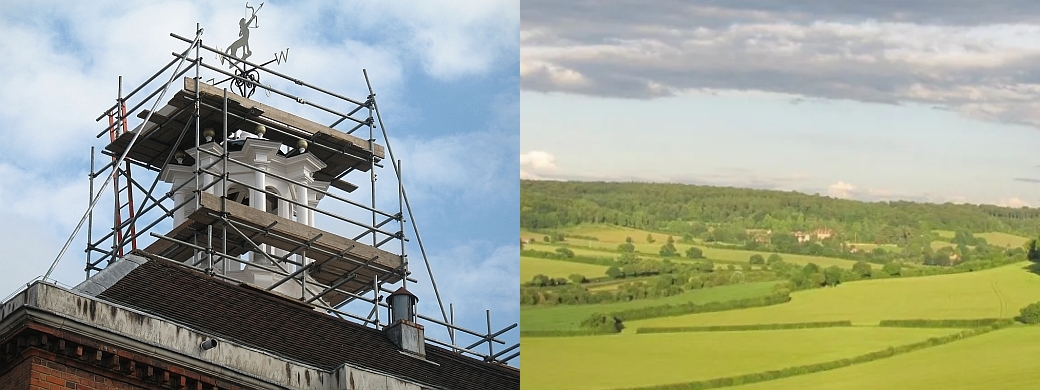
 For some months now, I’ve been drawn to the ordinary. I can’t exactly explain why. Perhaps something has rubbed off from walking the streets in Babylon Town and in this narrow valley. I live not far from little river which sneaks behind factories, workshops and the common dwellings put up for workers in the glory days of Empire, when Victoria was a goddess worshipped in the East. It’s a humble stream, hidden behind boundary fences, sometimes scuttling through culverts under roads; always furtive, even when it rushes down a few rocks into the culvert with a roar of white noise, rather like an air conditioning outlet – an unmarked waterfall. You can reach by shifting a garage bin chained to a gate at the side of a small warehouse. Caught in the cascade are broken umbrellas, plastic bags, discarded For Sale signs—variable jetsam according to season. Lower down you can find ducks and moorhens, but there’s nowhere for mothers to take their toddlers with crusts to feed them: not till you get to the public park, known as the Rye; and that’s quite a different part of town.
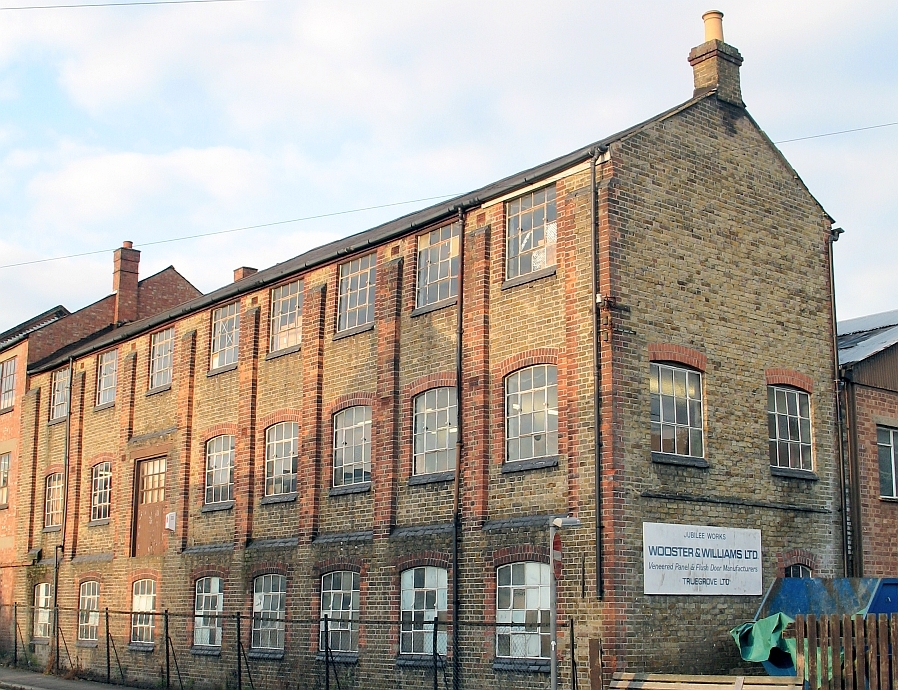
This part has long thrived on making things that people need, such as chairs and brushes; attracting immigrants in the nineteen-fifties from far-flung corners of the Empire, like St Vincent and the Grenadines or Kashmir. They brought along their Pentecostal and Muslim modes of worship, but now it’s the Poles causing the Catholic churches to overflow. A single furniture factory remains, making hand-crafted items in small volumes for a well-off clientele who appreciate traditional designs and the beauty of hardwoods. Most of the business premises in our valley have been in continuous use since Victorian times. They might look Dickensian but I suspect they have bestowed on their workers more dignity than squalor. There’s one in my street (illustrated) making laminated doors, staffed mainly by apprentices, white boys, as it happens. I asked my ever-helpful neighbour Mohammed where to get sheets of ply cut to size. He took me into the factory and asked the boys on my behalf. They didn’t charge me anything: it’s a neighbourhood interdependence thing, like the parking, the water supply, the alleys for access to backyards, the traffic flow. We’re a close-knit community, not shutting the world out but deeply linked to it. Go down our shopping street and everywhere you’ll get international phone cards; and you can make Western Union money transfers to dependents overseas. I heard a slogan yesterday which expresses the new morality for a threatened world: “Think globally, act locally”. That’s what happens in this valley of ordinary people.
And what is the ordinary? – Simple: it’s the opposite of “special”. So what then “special”? The opposite of ordinary. Perhaps you will dismiss the ordinary as not worthy of attention, with the sarcastic question “What’s so special about the ordinary?” The logical answer of course is “nothing”.
The ordinary is almost universally disregarded. Thinkers are bored with it. The masses yearn to escape it, through success or celebrity: if not actually then in fantasy. Am I any different? No, I am of the masses too. Till I am dead, I shall always want something, if only to keep moving, to have more in my life than endlessly repeated rituals.
In the simple idyll of my ordinariness, I find a joy in washing dishes, in walking to the shops, in eating and drinking and laughing and solving problems and creating new things. It’s true I don’t like TV and all that it represents of manipulating ordinary people. But it’s better than being a slave in the plantations or a child in the mines or cotton factories. Or their equivalents today. I could wish the whole world as peaceful as my valley.
Thursday, October 18, 2007
Being ordinary
There have been some news items lately in the UK about research studies which predict that in the next 20 or 40 years half the population will be obese. The second of these studies explained that it is not our fault: evolution cannot help us adapt quickly enough to new living conditions – in which junk food is cheap and we don’t need to do a lot of physical work to survive; and children don’t walk to school and their parents are scared to let them out to play and they sit indoors playing on computers or video games.
It’s a familiar story and not one which usually inspires me to any reaction, but I saw that there was a new element: it was expected that government must do something to solve the problem on behalf of the people. There is a context to this: in the UK the Health Service is free and so the Government cannot afford the cost of obesity and its effects on health. Accordingly they add even more legislation, further reducing individual freedom and responsibility.
I’m not writing this as a conventional right-wing libertarian who believes government should not interfere with the individual. I revolt against such views for their lack of compassion. I don’t believe in “the law of the jungle” when it means that the rich can become powerful and the powerful can become rich. I always identify myself with the wretched of the earth.
But – this is the crux of my position – I have trust in the ordinary man and woman. I don’t think governments need to tell us what to eat, how to bring up our children and how to keep ourselves safe. Governments should not insist on the labelling of food but stop the manipulation of ideas which makes people eat disgusting things like processed foods, which no self-respecting savage from the jungle would touch.
But I shall continue to practise rather than preach. I want to demonstrate in the laboratory of my own life that it is possible to follow instinct and live healthy and sane and harmless.
The problem with being ordinary is to accept the given values of your community. The report into obesity concluded that the people who got fat were simply going along with the crowd, practising normal human behaviour, including being influenced by TV advertisements, doing what their neighbours do and enjoying the fruits of their affluence by riding in four-wheeled carriages instead of walking – just as a rich man would have done in past centuries.
I don’t argue with their findings. I just think it is terrible if there are more rules and if we get even further from instinct.
In me it is easy because I am practised in not following the crowd. K thinks I behave differently on purpose. It is true I question authority, I despise the crowd. But I greatly respect the ordinary man woman and child and their innate wisdom.
What we call civilisation is dangerously near collapse, on several fronts. Nature wants to straighten things out. Global warming is dangerous for civilisation but it would be good for nature if the oil runs out and we have to live locally on local resources and ditch much of our energy-dependent technology.
I just want to live simply in my neighbourhood.
This was an experiment in trying to express myself without premeditation in a few minutes. Bear with me. The time is running out!
Monday, October 15, 2007
Root and Flower
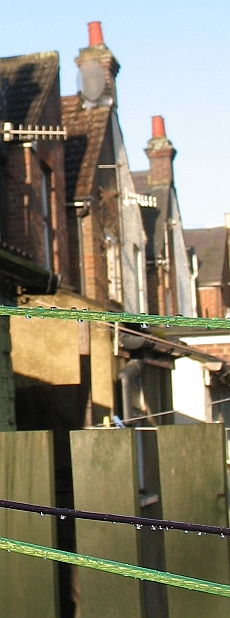 Pic: dew on the washing-line.
If the inner life is the root of my existence, I consider writing to be the flower: I mean the expression, the flamboyance containing the immature seed. The flower’s gaudiness and scent is to attract bees who bring pollen from other flowers. Their visit is a sexual consummation. From that point, the seed swells and through one of a great collection of valid engineering solutions that nature has invented is sent to fresh soil away from the parent. This is my life as a plant: to be deep-rooted but yet to interact with the entire world. (NB As I wrote this I re-opened the blog to everybody.)
It was therefore a kind of trauma to find myself recently prevented from writing. To be transplanted is a crisis and if you see the plant wilt, don’t imagine it has given up. On the contrary, it’s making a supreme effort where keeping up appearances takes second place to survival.
It’s four weeks since I moved to this new house. I must find it a name. It’s 109 years old. An American would express himself more clearly, explaining that his new home is an old building. But in England we wouldn’t say that. You could speak of finding a new home for a cat or dog. You could send your aged relative to a “home” (a care home for the elderly). But we never say “home” to mean the bricks and mortar. Home is a concept, “chez moi”, “my place”. I imagine that in America it started as a marketing idea – to sell a home and not just a house. Here, though some marketers may have adopted the same term, we know it’s impossible to buy and sell homes.
The house we moved into a month ago had been a home, but that day we moved into an empty shell, an abandoned nest left stuck in a tree. It’s taken all this time and the depletion of energy reserves to a dangerous level to achieve the transformation. I’ve traversed a spectrum of emotions that seems to cover most of human experience and perhaps that of other mammals and even insects, who knows? There have been sharp catastrophes and bewildering miasmas, but none of them is worth the telling. I simply give thanks to have been through it and even more to have come out of it whole.
Out of my window the sun shines. (That was when I was composing this epistle: in this internet cafe there is no sunshine, only a draught from the back door and a mess of pistachio shells next to the keyboard left by an earlier customer.) The crab-apple tree stands in glory with leaves of orange and yellow and some still green and others falling, at the rate of one every few seconds now, as Autumn visits this latitude. Houses, each one a home to its denizens, cling to the southern slopes of The Pastures like sea-birds’ nests on a cliff serene and safe above the raging ocean.
I prefer “inner life” to “spirituality” for that word carries too much religious and philosophical baggage. I’ll stick to the metaphors which arise spontaneously, such as “roots” or if you will “sources”. For joy must come from somewhere. Not “Source” in the singular with a capital letter for that’s just a code word for God, sliding the baggage in again by the back door. No! Let the airline lose those bags, or send them to Shanghai for all I care. Leave me with the clothes I stand up in, and those roots from which I gratefully draw nourishment more precious than gold.
Saturday, October 13, 2007
Joy of home
A bird in a cage sings more sweetly, they used to say; and no one is more lyrical than the exile. Now that I have come home from exile, able to build a nest in freedom – that is to say bought a cosy little house – I’ve not written a thing. Plenty of excuses of course. Computer not set up (what’s wrong with my beloved fountain-pen and sacred notebook?); too many pressing and exhausting tasks, more than enough to fill each day (all the more reason to take time off and write); no internet connection (doesn’t prevent me from drafting out a piece anyhow and transcribing it in the internet café – which is what I’m doing now).
K had said we’d be nostalgic about the flat we’ve just left. But I don’t miss the apartment itself, or if I do, I only have to reassemble it as a full-size model in memory, with all its shortcomings and overcomings. When you sat back on the sofa, the springs dug into your back. I had to make sure guests never sat on it. when we offered food to guests, the camping table normally kept in a cupboard would be unfolded and used for a buffet.
Now, we have a lounge and separate dining-room adjoining the kitchen, and 3 bedrooms upstairs. Not grand though. It’s a dark little house because old English cottages up to Victorian times tend to have small windows. My computer desk (that Singer sewing-machine that reminded me of childhood homework when we first moved to Isle of Wight) is not very ergonomic for a grown man: the swung-down & concealed sewing machine gets in the way of one’s knees. There’ll always be scope for overcoming in this life—I wrote in this blog a few weeks ago of those smart houses in Babylon Town that seemed over-finished, like expensive coffins. This house is not like that!
We were given this place, that’s the only way to describe how it feels. But I have not been keeping that focus. It’s a form of craziness to think I am making it all happen. At this moment I feel once more that sense of gratitude that has been painfully missing these last few weeks when struggling on top of a ladder or at the ironmonger’s searching for the right kind of screws. Those are necessary tasks but they distract from the passive enjoyment of divine warmth: that so precious experience which has inspired every religion.
It’s the feast of Eid at the end of the fasting month Ramadan: a time of great joy in these streets as Muslims flock to the mosque at various times in their white robes and crocheted caps. Sometimes the service is held outside, or is it just an overflow from the main hall? Worship and gratitude are certainly overflowing. Islam is impressing me more than Christianity: the Baptist Church next to the Mosque is a dour place where nothing much happens except on a Sunday. But I won’t lose my overall perspective that every religion and every idea of God is a mild heresy against experience, just as a political party cannot help twisting the facts. Religion is merely a cup to hold the wine when it’s shared.
I’ve positioned the sewing-machine – the computer I should say – to view a microcosm from the upper back window as I ponder and write. Lots of sky; a crab-apple tree in the public playground tht drops fruit in our backyard; an acacia that drops pea-like pods everywhere. Behind these rises the hill crowded with houses built in the last 20 years. but still called The Pastures. My Ordnance Survey map from the Fifties shows nothing but contour lines, public footpaths and a few old cottages. Mercifully all those footpaths have been protected and you can still walk them, evn through the housing estates. At the front of our house on the opposite side of the road is one marked “Hill View 1898”, but sadly for its purchaser that view was permanently blocked when our house was built.
It’s a joy to observe from my window the visitors to the playground, and watch pedestrians pass to and fro on the nondescript street beyond: some returning with shopping bags; some going to work, some on their way to the mosque. In the evening, young men gather in twos and threes talking, some riding the swings or addressing their mobile phones. At that time they are silhouetted by a dim streetlamp and I cannot tell if they are white or Asian or West Indian. The differences are always fascinating. As I write this morning, a group of seven Asian teenagers gathers restlessly under the acacia tree, apparently planning some harmless mischief. Others more earnest stride back from the mosque. As I passed through the playground on my way to this internet cafe, a tall Rastaman (dreadlocked West Indian) leapt over the low fence and greeted some Asian youths with a “Merry Christmas”. They replied with some reminiscence of last time. Perhaps the sharing of spliffs was involved, for this Rasta was high on something. His companion was more grizzled, his grey shaggy beard tied in a bizarre tangled knot under his chin.
Dear friends, it is an honour to address you thus, and to invite you to my home – verbally for now, but who knows? Do we know how much we are blessed? How can we share our blessings with those who lack?


 a wayfarer’s notes