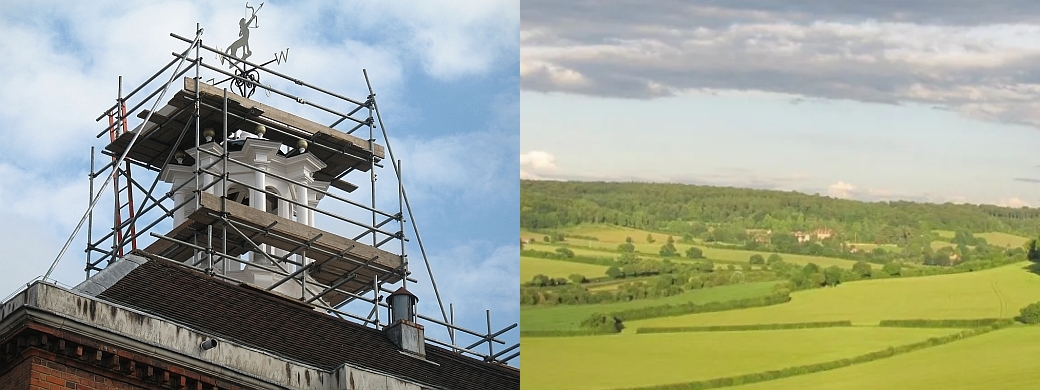


X marks the spot. PH: “public house” (Crown Inn)
A few weeks ago, Karleen and I had taken a cross-country walk near the ancient Buckinghamshire village of Penn. The Penns of Penn were reputed to be closely connected to William Penn of Pennsylvania, but in any case many religious dissenters from these parts had emigrated and helped found the town of Burlington over there, and in memory of their birthplace gave the name to Bucks County. Bucks has long been the official abbreviation for Buckinghamshire. The attraction for Karleen and me, though, is the 17th century inn, The Crown, built by the Penn family.
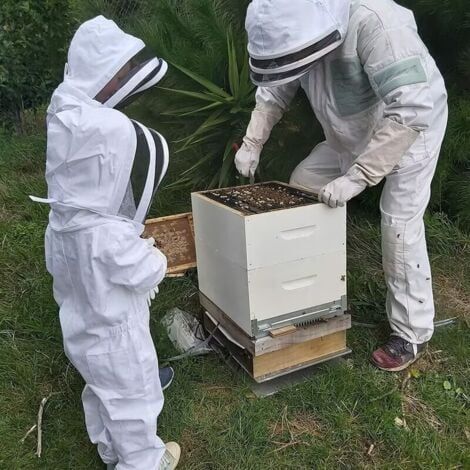
As we walked through a field of yellow-flowering oilseed rape, bordered with field pansies and other wild-flowers, we spotted some odd movements at the top, just in front of a little copse. They were repetitive, up and down, and we wondered if it was some white rags, caught on the thorns, flapping in the wind. But as we got closer, it seemed to be two figures, clad in white, their heads bobbing up and down, then staying down for a while. Advancing all the while, we now saw it was three figures, all in white, apparently hooded. This has never been a haunt of the Ku Klux Klan, so it was baffling.
I never go on walks without being intensely curious about everything I see: birds, flowers, insects, stones, scraps of paper, fossils, lichen, footprints. Karleen often tells me to “Put it down, it’s dirty!” as if she were leading her toddler to nursery-school. So, as we got closer, I strongly desired to divert our walk to pass these people and find out what they were up to. But coming as she does from a violent country where you mind your own business to stay alive, she didn’t let me go nearer, in case they decided to liquidate witnesses. It was frustrating because the height of the rape crop and the curvature of the land prevented a full view unless I got very close.
 I left with regret, unanswered questions churning in my brain. Were they burying treasure, or a cache of illegal things? Or digging them up? Then I hit on the most likely explanation. It was a police forensic team, dressed in their protective paper suits, who had discovered the decayed body of a man, woman or child. They were photographing, fingerprinting, combing the ground for evidence. This explanation answered all points, and I resolved to check the local papers to get confirmation. Then I forgot all about it.
Forgot, that is, until last night, when we returned for a meal and a pint of good English ale at The Crown. I persuaded Karleen afterwards to accompany me to the site. It was about three weeks after the distant witnessing of the “goings-on”, but I was sure there would be some evidence left behind. In mid-June, the crops and wild plants are at their full growth. Any intense activity such as we had witnessed would have left signs: recently-dug soil, trampled vegetation or discarded objects to aid the amateur sleuth.
 Karleen was nervous as we tramped through the long grass, as if fearful of booby-traps. On our right was the copse, a private wood where they encourage young pheasants to breed ready for the shooting season. On our left was a glorious, unspoilt landscape, part of the historic Chiltern Hundreds: undulating meadows and woods, with a few distant red brick farm buildings. I swear it would have looked no different on a sunny June evening four hundred years ago. I was starting to think there would be nothing of note to find, but when we were about thirty paces away, I saw something like a pile of grey wooden boxes, but I couldn’t be sure. Perhaps the three hooded men in white had left behind their treasure.
A suspicion formed in my mind. We reached the spot, to investigate at close quarters. There were eight or ten busy beehives.
 a wayfarer’s notes