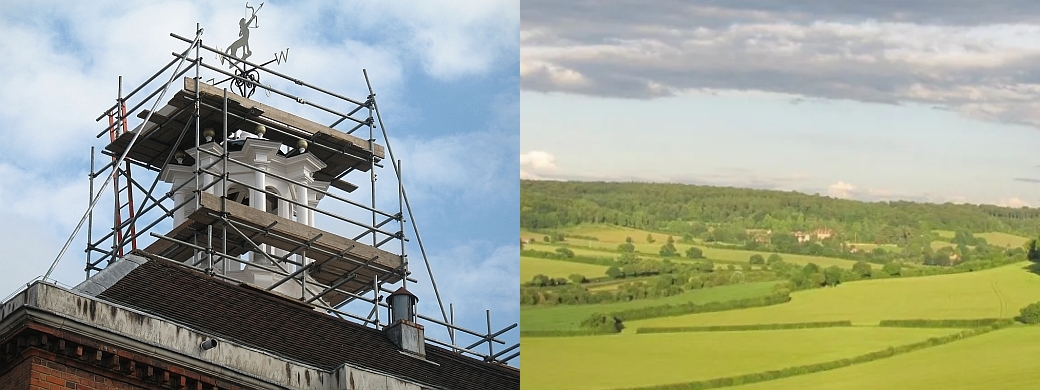

26th April
Spring is the most important thing happening here. I’ve been watching the progress of chestnut blossom at the back of our upstairs flat. There’s no garden, just a communal car park, then a fenced-off slope up to the railway. This young tree hangs over the fence, offering itself as a measure of the advancing season, whenever I come down to empty the kitchen bin.
I’ve never watched Spring unfold so eagerly. It mirrors my own joy. The other day I was reading a piece on Cheerfulness. Here’s an excerpt:
Cheerfulness has close links and affinities with humour. Speaking playfully, one may call cheerfulness a “younger brother” of humour: but there can be humour without cheerfulness, which is serene, good natured, and smiling. Maybe cheerfulness is joy’s younger brother? Cheerfulness opens the way to joy and promotes its manifestations. Conversely, joy includes the state of mind which is cheerfulness.
(I shall refer to this later when dealing with Franciscan joy).
I don’t agree with him. My joy is something inside. It doesn’t respond to his analysis.
The piece mentioned is from Roberto  http://two.not2.org/psychosynthesis/articles/Cheerfulness.pdf I’ve edited the excerpt slightly.
I’m part of the advice industry now, that section of it which helps with “how to live your life”. Pretty lethal, eh? Wrong advice could wreck the recipient’s life or at least waste precious time. Rigorous standards are needed to curb the unconsidered foolishness of ministers of religion, therapists, coaches, gurus of all kinds.
Of course such people have to exist, by popular demand. But one should beware. Please for your own good apply these criteria and make sure your advisor shapes up.
1) Only one kind of advice should ever be given: “Be who you are”.
2) The advisor must make an honest attempt to follow up outcomes and side-effects.
3) Any advisor who says that outcomes are unmeasurable, or claims the advice harmless, or that it has always worked, is unworthy and should be forbidden to practise.
After mentally offering this advice to the entire world, I took time off and renovated this old lamp. Jan Mulder (the man who was not, as I eventually discovered, my father) brought it from Java as a present for my grandfather in about 1936, where it sat beside him in his study, begrimed with pipe smoke, for perhaps forty years. The other day I retrieved it, and put the charity lampshade on it. I’d always known this old man and his dog (?) as having one eye each. Fixing them up with binocular vision seems to be my most satisfying achievement today. If I could make and mend every day, my creative instincts might be satisfied & I’d never write, let alone preach.
I have to give a talk in a few days. Will anyone turn up? I have sent some invitations to experts in a closely-related field. Will they patronise me or try to put me down, for poking my barely-trained nose into their territory? How extempore can I dare to be? I don’t feel like planning it too much, and yet I know that between now and then I will feel so uncomfortable about it that I will have to produce some notes on paper.
Here are some of those flowers that come out in the time of tulips. Oh, what are they called? How could I forget? “Forget-me-not!”
6th May
There are various products of evolution which fascinate me endlessly – the domestic cockerel gallus gallus, the peacock, the cock pheasant, the horse chestnut, especially its blossom; the durian, that aromatic fruit from south-east Asia. There is mystery about their showy natures, their gratuitous glory.
Here the chestnut cycle unfolds daily and there is one at the back of our flat, overhanging the car park. Share with me its extraordinary beauty!
My head said I should be nervous about giving that talk, but I wasn’t at all. In the morning I went to the park and spread the picnic rug near a great swathe of now-withered daffodils. Here in the sunshine I jotted my notes. A couple of cheery grey-haired ladies came past and asked if I was “doing a Wordsworth” – writing an ode, I suppose. I told them about the imminent talk. “Shouldn’t you be in a darkened room for such a serious task?” The banter continued. All I can remember saying is that I might just give a talk on happiness.
Later in the day I realised that whilst the my script for the first part of the talk was OK, the rest was hampered by lack of adequate preparation, and there was no longer enough time. I rehearsed it with K. She agreed with my verdict. Yet my mood of lightness, gaiety, or perhaps I should say profound happiness, stayed unaffected by nervousness. I just knew it would be OK.
As indeed it was. The owner of the venue runs a café, and has an upstairs room for small meetings. She’d laid out a few chairs and when no one showed up wasn’t bothered at all, but interested in what I had to say.
So I ditched the script and we did it interactively. You could call it an interview, with me answering her questions; or perhaps it was just a conversation.
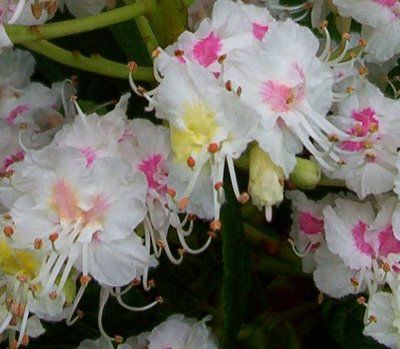 Here is an update on chestnut blossom. The buds appear on the frond in groups of eight. The eight consist of four pairs. Within a pair, one is pink centred and the other is lemon yellow. The same miraculous phenomenon occurs regardless of the main blossom colour of the tree. I saw somewhere a tentative explanation. Apparently the colour changes when fertilisation has taken place and this tells the bees that the nectar has been taken. Can you believe such a thing?
I had another blog for a year or two, called Discoveries. I destroyed it and that felt good. This one started off being called “An Ongoing experiment”. I’ve made different rules for myself this time. I can amend any entry! So it’s a constant re-creation. It’s not a memorial. It lives and breathes, like life itself. It bows to the influence of its readers. So I don’t know where it will go.
12th May
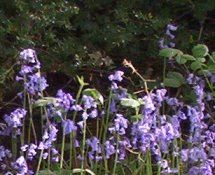 Walked from Great Missenden to a wood where bluebells grow in the beech trees’ shade. I’m neither a photographer nor a haiku poet like Basho, who wandered through Japan in the 17th century like a nature-tourist, though he was more of a Zen mendicant pilgrim.
It wasn’t the bluebells themselves which conveyed the sense of joy that I felt in this morning’s sunshine. It was much more a gratitude for my life. And this gratitude and joy, which comes late in life, demands to be shared with those parts of creation which remain in pain and grief even on this day that’s so glorious in Buckinghamshire, England.
There is a flow. I may have trashed the New Age formulas I referred to yesterday, but whatever is true, I let it flow through me. As Douglas Adams said, all we know is, “What happens, happens”. And by the same token, what’s true is true.
As it happens, the calendar on the wall has this to say for May 2006:
“When you are alert and contemplate a flower, crystal or bird without naming it mentally, it becomes a window for you into the formless. There is an inner opening, however slight, into the realm of spirit.”
And it says this comes from Eckhart Tolle’s book, A New Earth. I’m not endorsing Tolle. I haven’t read his book and the calendar was a gift. Like Descartes, I am trying to doubt everything, and I am not sure about “the realm of spirit”. “I feel, therefore I am” would be a good motto for where I’m at.
14th May
Am I the only devotee of chestnut blossom in its close-up form? My interest started in about 1992, when I observed the phenomenon in Brent Lodge Park. After that, an illness prevented me from going out and about much. Walking the earth and admiring the handiwork of its creator (so to speak) became a defiant act of imagination, as opposed to a real activity. So now, when the season and opportunity coincide, I can’t get enough of these flowers, gazing in wonder and pondering their mystery.
So let me ask. Why do adjacent blossoms have different colours? If Darwin is right, there is some evolutionary advantage. I wish I knew how to find out.
PS “Many flowers that are attractive to bees have an irregular shape that provides a landing platform. They also have flower markings that guide bees in to land on the part of the flower where it can deliver and collect pollen grains. Horse-chestnut tree flowers are cream colored with a yellow honey-guide patch on the petals. When nectar dries up, the yellow patch turns pink, becoming invisible to bees. Bees visits only the flowers that need pollination.” Thanks to Massachusetts Agriculture In The Classroom But I don’t think this is the full story, because there are at least three colours as in my illustration, and they are like this from the start. I have not seen any blossom clusters where all are yellow or all are pink.
PPS Here is a link to a UK site which provides some clues and some experiments to conduct.
 a wayfarer’s notes